Intro
If you have never heard of future house before, what would you think it would sound like? Personally, I thought it would sound like dubstep space phasers over a hyped up house beat. Turns out I was wrong (mostly). Wikipedia sums it up as "a fusion between deep house and EDM." I would say it's a twist on 90s house synths over deep house kicks.
Tuesday, January 12, 2016

Sunday, March 30, 2014
[Critique]No Bird Sing - Definition Sickness
Personal Intro
I've only been listening to No Bird Sing since before the release of Theft of the Commons. My introduction to this group was met when I was looking for collaborations with Eyedea. I fell in love with the abstract rhythms and sound in the song Dream (ft. Eyedea) which lead me to buy No Bird Sing's debut album. I became addicted to the three-piece group analyzing every word Joe Horton spoke, getting lost in the auditory landscape created by Robert Mulrennan and Graham O'Brian. Theft of the Common left me disappointed. It felt too forced and with too much angst.
Definition Sickness
I was pretty uncertain about purchasing this album after Theft of the Commons.
Would they continue to push towards the edgy/dramatic sound of their second album?
Maybe they will go back to the softer philosophical tone of No Bird Sing?
They managed both. Very well.
The production of this album is much richer and much much darker, instrumentally, lyrically, and thematically. Songs range from love, hate, racism, drugs, and death. Joe Horton directed these themes with maturity. He alludes to Micheal Larsen's works many times throughout the album. Some of the patterns he executes gives some reminiscence of Micheal. My only complaint about the album is that I want to hear more of No Bird Sing with less features and less allusion's to Oliver Hart (which was a fantastic album, don't get me wrong).
Album analysis soon to follow.
Monday, October 21, 2013
[Critique]Tomas Kalnoky in Everything Goes Numb
I love Streetlight Manifesto, ever since I first heard his single "What a Wicked Gang are We," on a punk radio station. At first, I was more intrigued about the sound rather than taking a liking to it. I ended up dismissing it as odd, but to be fair, "What a Wicked Gang are We," is probably not the best song to introduce someone to Streetlight. Overtime, I ended-up downloading singles from P2P software like Bearshare for over a year before finally buying all of the albums chronologically (Everything Goes Numb to Somewhere in the Between). It was 2008 and I was fourteen when I was introduced to Streetlight.
They we still relatively unknown in the area I live in. A trombone player primarily, and a bass player when no-one wants to hear it, I could relate. Tomas Kalnoky somehow intrigued me in every-way, every-time I listened to a track (I listened to them everyday from my freshman year to the beginning of my senior year). He inspired me to write my own lyrics, but I was a musician not a lyricist, so trying to write in his caliber was never going to happen. Through time, I was able to grasp literary concepts with the help of my AP classes.
I'm writing this because I haven't studied Streetlight since high-school and only listened to "The Hand that Thieve" twice through - except today. I will be sharing with you an overview on the writing style in Everything Goes Numb and how he invokes a sense a meaning without actually meaning anything (mostly).

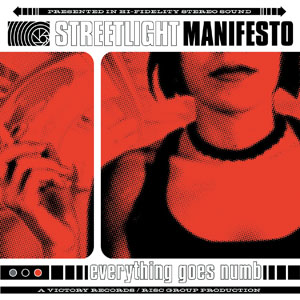
Is Streetlight Manifesto's first album and is the very first ska album I owned. This album is very dark and rings back to Tomas Kalnoky's grunge "Gimp" days with darker horn lines that convey a sense of energized apathy. Most of this album is about suicide, apathy, and angst. Even though I was fourteen, I wondered how this related to me, but somehow it did. He relates to us using pronouns but keeps it first person by using "I." It's not uncommon, but he also uses the pronouns to keep his lyrics vague, so vague that it pisses me off when I try to look into them. I mostly ask myself, "Who is he talking to so angrily?"
Tomas doesn't tell us anything, like punk bands do, he telling us a story by talking to someone else. The themes in the album don't become too obvious 'til "Point/Counterpoint" or even "If and When We Rise Again." If you turn the volume up on "If and When We Rise Again," you can hear a voice say, "moderate rock," which alludes to Nirvana. Everyone knows Nirvana, or at least what trend they set. So Tomas Kalnoky is definitely speaking to generation x throughout this album. Maybe that's why I always felt marginalized?
"Here's to Life," is another key track on the album with allusions to authors and K.D.C. - Kurt Donald Cobain. The authors, Camus, Holden Caufield, Hemingway, and Salinger, are authors who write about social ethics and instability. Maybe Tomas is talking to Kurt, and is angry that he left everyone behind?
"The Big Sleep," is one of my favorite songs off the album. I would like to think that this is a transition piece into Somewhere in the Between. He doesn't hold back on the emotional power of the lyrics either.
The last two soldiers on the battlefield
survivors of the war
they aim at one another while their mothers beg the lord
"if you're listening, i'm missing him so somehow bring him home,"
how did it come to this?
so the soldiers lift their rifles they're aiming at the head
they think of their first love before they take their final breaths
and some where in the distance they hear something someone said:
"how did it come to this?"
Have any input about the album? Write in the comments below!
Support! http://pentimentomusic.com/
They we still relatively unknown in the area I live in. A trombone player primarily, and a bass player when no-one wants to hear it, I could relate. Tomas Kalnoky somehow intrigued me in every-way, every-time I listened to a track (I listened to them everyday from my freshman year to the beginning of my senior year). He inspired me to write my own lyrics, but I was a musician not a lyricist, so trying to write in his caliber was never going to happen. Through time, I was able to grasp literary concepts with the help of my AP classes.
I'm writing this because I haven't studied Streetlight since high-school and only listened to "The Hand that Thieve" twice through - except today. I will be sharing with you an overview on the writing style in Everything Goes Numb and how he invokes a sense a meaning without actually meaning anything (mostly).
Everything Goes Numb
Tomas doesn't tell us anything, like punk bands do, he telling us a story by talking to someone else. The themes in the album don't become too obvious 'til "Point/Counterpoint" or even "If and When We Rise Again." If you turn the volume up on "If and When We Rise Again," you can hear a voice say, "moderate rock," which alludes to Nirvana. Everyone knows Nirvana, or at least what trend they set. So Tomas Kalnoky is definitely speaking to generation x throughout this album. Maybe that's why I always felt marginalized?
"Here's to Life," is another key track on the album with allusions to authors and K.D.C. - Kurt Donald Cobain. The authors, Camus, Holden Caufield, Hemingway, and Salinger, are authors who write about social ethics and instability. Maybe Tomas is talking to Kurt, and is angry that he left everyone behind?
"The Big Sleep," is one of my favorite songs off the album. I would like to think that this is a transition piece into Somewhere in the Between. He doesn't hold back on the emotional power of the lyrics either.
The last two soldiers on the battlefield
survivors of the war
they aim at one another while their mothers beg the lord
"if you're listening, i'm missing him so somehow bring him home,"
how did it come to this?
so the soldiers lift their rifles they're aiming at the head
they think of their first love before they take their final breaths
and some where in the distance they hear something someone said:
"how did it come to this?"
Have any input about the album? Write in the comments below!
Support! http://pentimentomusic.com/
Subscribe to:
Posts (Atom)