
They we still relatively unknown in the area I live in. A trombone player primarily, and a bass player when no-one wants to hear it, I could relate. Tomas Kalnoky somehow intrigued me in every-way, every-time I listened to a track (I listened to them everyday from my freshman year to the beginning of my senior year). He inspired me to write my own lyrics, but I was a musician not a lyricist, so trying to write in his caliber was never going to happen. Through time, I was able to grasp literary concepts with the help of my AP classes.
I'm writing this because I haven't studied Streetlight since high-school and only listened to "The Hand that Thieve" twice through - except today. I will be sharing with you an overview on the writing style in Everything Goes Numb and how he invokes a sense a meaning without actually meaning anything (mostly).
Everything Goes Numb
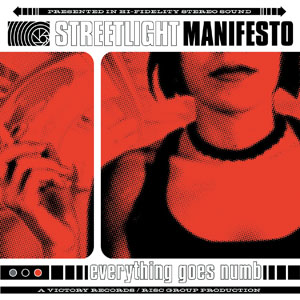
Tomas doesn't tell us anything, like punk bands do, he telling us a story by talking to someone else. The themes in the album don't become too obvious 'til "Point/Counterpoint" or even "If and When We Rise Again." If you turn the volume up on "If and When We Rise Again," you can hear a voice say, "moderate rock," which alludes to Nirvana. Everyone knows Nirvana, or at least what trend they set. So Tomas Kalnoky is definitely speaking to generation x throughout this album. Maybe that's why I always felt marginalized?
"Here's to Life," is another key track on the album with allusions to authors and K.D.C. - Kurt Donald Cobain. The authors, Camus, Holden Caufield, Hemingway, and Salinger, are authors who write about social ethics and instability. Maybe Tomas is talking to Kurt, and is angry that he left everyone behind?
"The Big Sleep," is one of my favorite songs off the album. I would like to think that this is a transition piece into Somewhere in the Between. He doesn't hold back on the emotional power of the lyrics either.
The last two soldiers on the battlefield
survivors of the war
they aim at one another while their mothers beg the lord
"if you're listening, i'm missing him so somehow bring him home,"
how did it come to this?
so the soldiers lift their rifles they're aiming at the head
they think of their first love before they take their final breaths
and some where in the distance they hear something someone said:
"how did it come to this?"
Have any input about the album? Write in the comments below!
Support! http://pentimentomusic.com/

No comments:
Post a Comment